



17.4.4 Student's sustainability literacy
Batterjee Medical College · SDG 17: Partnerships for the Goals
Read the full SDG 17 report and the evidence documented by BMC.
Overview
BMC operates a formalized, institution-wide Sustainability Literacy Assessment System that systematically measures how students learn, retain, and apply core sustainability concepts, policies, and SDG practices across their academic and co-curricular lifecycle.
1) Institution-Wide Sustainability Literacy Measurement:
The BMC Community Sustainability Survey 2025 (Blue Analytics System)
BMC implemented a comprehensive, college-wide BMC Community Sustainability Survey for Sustainable Development Goals – Student Edition via its enterprise Blue assessment platform.
Survey Scope
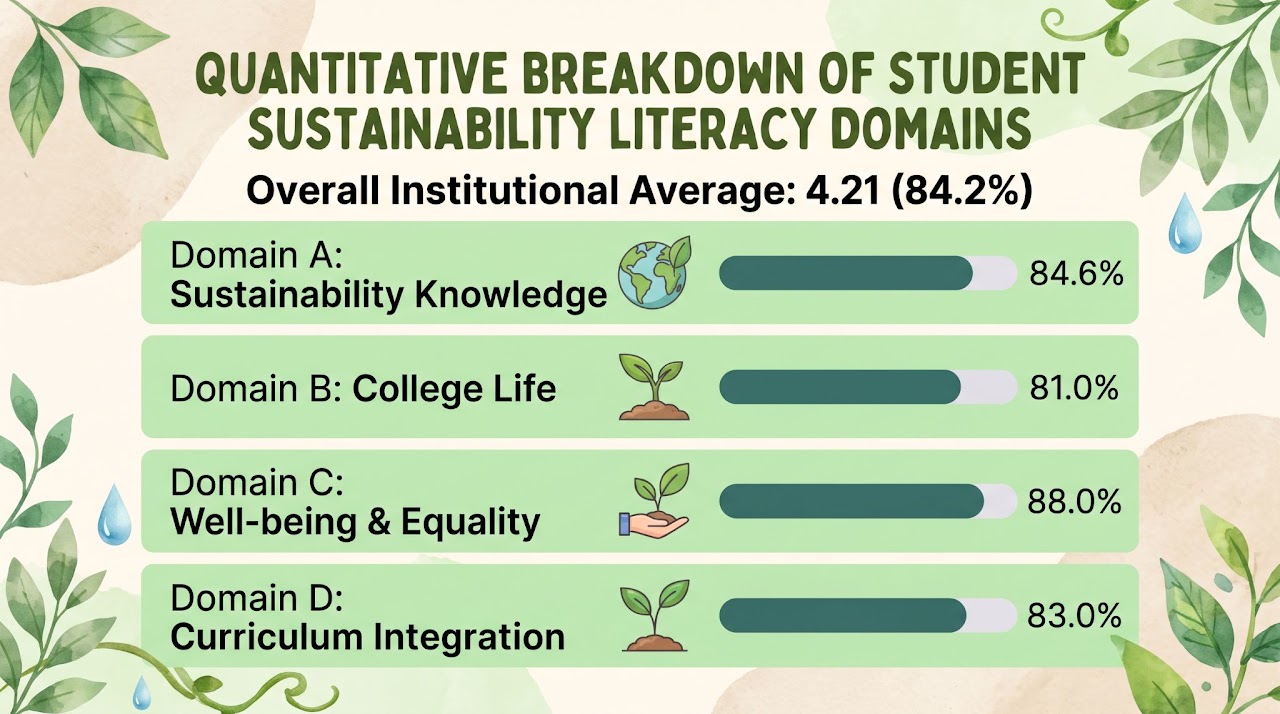
Overall Sustainability Literacy & Competency Benchmark
2) Qualitative Student Literacy & "Data-to-Action" Feedback Loop
Section E of the BMC Community Sustainability Survey 2025 ("Any suggestions you have to improve the sustainability practices on campus?") evaluates students’ critical thinking and applied problem-solving regarding environmental and social sustainability. Qualitative responses demonstrated advanced student sustainability literacy across key technical areas:
- 01Circular Economy & Microplastics Literacy: Students proposed structured campus item-exchange/trading events governed by hygiene standards to reduce waste, paper and fabric recycling workshops, scientific seminars on microplastic health hazards, and eco-friendly, medically validated feminine hygiene solutions.
- 02Water Harvesting & Native Xeriscaping: Students recommended expanding sustainable campus landscaping using drought-tolerant native flora irrigated via harvested rainwater and recycled greywater to minimize freshwater consumption.
- 03Closed-Loop Institutional Action: BMC’s Social Responsibility and Sustainability Unit and Campus Operations directly translated these student literacy insights into concrete campus interventions, including the 4th Annual Book Swap (circular economy reuse), the Eco-Friendly DIY Natural Skincare Workshop (eliminating synthetic chemicals and single-use plastics), the Women’s Menstrual Health & Kotex Campaign, and the planting of 1,000+ native seedlings on campus with the Ministry of Environment, Water and Agriculture alongside greywater recycling and rainwater harvesting upgrades.
3) Direct Curricular & Co-Curricular Assessment of Student SDG Literacy
Complementing the college-wide survey, BMC evaluates student retention of sustainability concepts through four direct academic assessment mechanisms:
I. Direct CLO-to-SDG Attainment Tracking via ExamSoft & QQ® Assessment Solution:
- 01Every BMC course specification explicitly maps Course Learning Outcomes (CLOs) to relevant SDGs (e.g., RAD 213 X-ray Imaging Equipment mapped to SDGs 3, 4, 9; RAD 323 Nuclear Medicine Imaging Techniques mapped to SDGs 3, 4, 16; LHC 291 Leadership in Healthcare mapped to SDGs 3, 4, 8, 9, 16; and QPS 291 Quality and Patient Safety mapped to SDGs 3, 4, 16).
- 02Using ExamSoft, Blackboard Learn Ultra, and the QQ® Assessment Solution, BMC links examination questions (MCQs, SAQs, practical OSPE/OSCEs, and case studies) directly to SDG-aligned CLOs, generating automated end-of-semester QQ® Reports and Item Analysis Reports to audit student mastery of sustainability competencies.
II. Pre- and Post-Intervention Thematic Literacy Quizzes:
During targeted campus campaigns, BMC conducts diagnostic pre- and post-intervention literacy testing, such as the Healthcare Ethics & Informed Consent Quiz during the Women’s Health Empowerment campaign and the World Mental Health Literacy & Screening Assessment.
III. Competency-Based Evaluation (CBE) of Student SDG Research & Posters:
Students are formally graded on applied sustainability research during mandatory Poster Presentation Days (such as the 3rd-Year Medicine Clinical Nutrition & Research Methodology Poster Day, and the Health Management Universal Health Coverage & Women’s Health Policy Poster Day) and annual BMC Scientific Research Forums, where students present peer-reviewed studies on fast-fashion environmental footprints (SDG 12), improper pharmaceutical disposal and aquatic bioaccumulation (SDG 6, 12, 14), NEOM renewable energy models (SDG 7, 11), and Saudi Vision 2030 SDG alignment (SDG 3, 17).
IV. Enterprise Digital Learning Analytics (edX Data Package & AI Mentoring Matrices):
Through BMC’s enterprise agreement with edX LLC and AI (Claude)-Enhanced Academic Mentoring Matrices, BMC tracks student enrollment, assessment scores, and certificate completion across global sustainability and healthcare courses.
Documents & evidence.
Official policies, reports and records supporting this page.
Activities in pictures.
Documented initiatives, events and evidence from across BMC campuses.


Building a sustainable future together.
Explore the full report and the evidence behind BMC’s commitment to the Sustainable Development Goals.

